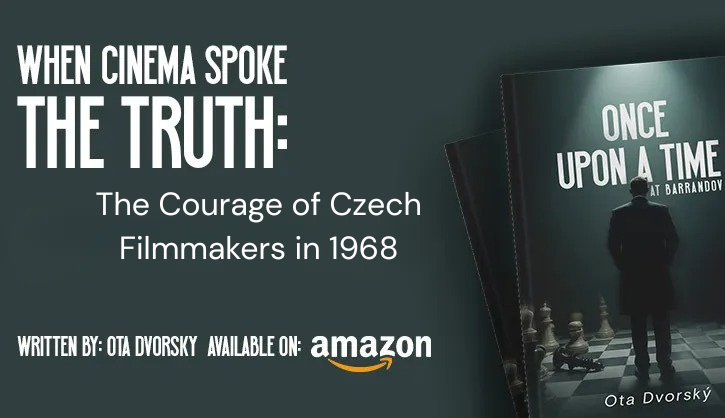
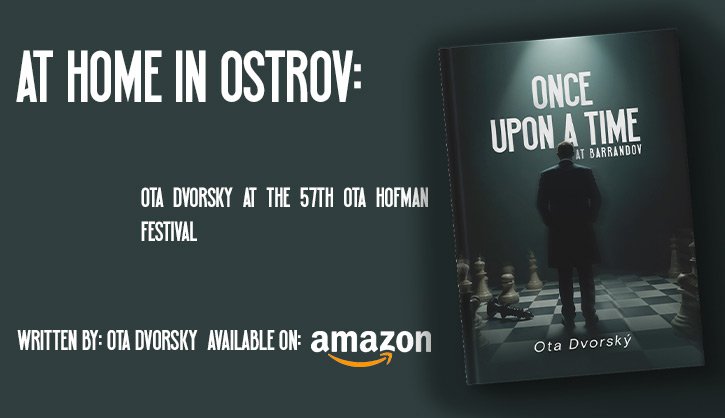
When a writer’s life grows out of another writer’s legacy, the task is both an honour and a responsibility. For Ota Dvorský, that inheritance comes from a direct source: his father, Ota Hofman, one of Czechoslovakia’s most beloved creators of children’s stories and screenplays. Dvorský’s new novel, Once Upon a Time at Barrandov, is an act of cultural preservation as much as it is an artistic statement, a way of keeping alive the craft, the context, and the courage that shaped a generation of Czech filmmakers and storytellers.
Hofman’s work for children, best known internationally through the pantomimic, bowler-hatted figure Pan Tau, helped shape the contours of modern Czech children’s cinema. Pan Tau’s gentle magic, clever problem-solving, and cross-cultural appeal made the series a rare bridge between East and West at a time when such connections were rare. The role of Barrandov Studios in this story cannot be overstated: the studio was both an incubator of talent and, during politically fraught years like 1968, a fragile space for artistic expression that required courage to navigate. Pan Tau’s international resonance and Hofman’s influence point to a cultural tradition that valued imagination even in constrained circumstances Johndclare.net, 2015.
In Once Upon a Time at Barrandov, Dvorský draws on this heritage to tell a larger story: how artists persist in making work that matters when the political weather turns hostile. The novel reconstructs moments at Barrandov pressurised editorial rooms, late-night script rewrites, the hush of a set right before a take and places creative people at the centre of history. In these scenes, the practical tools of filmmaking become instruments of ethical decision-making. A rewrite is no longer just a creative fix; it’s an attempt to outmanoeuvre censorship. A child’s puppet, a small prop, or a sly line of dialogue can carry meaning that official channels would never allow. Dvorský’s writing imagines how such choices looked, felt, and sounded from inside the studio walls.
But the book is not merely a historical reconstruction. It is also a loving tribute to the people who laboured on those sets, and to Hofman’s ethos of storytelling that respected children as intelligent, emotionally complex readers and viewers. Hofman believed that children’s stories should not be condescending but should treat young audiences as capable of understanding layered meanings. That moral seriousness is a guiding thread in Dvorský’s novel: the characters he animates are not caricatures of resistance, but human beings with doubts, small acts of bravery, and a persistent willingness to create beauty Steiling, n.d.
This approach does two important things. First, it preserves cultural memory. Many of the technicians, writers, and designers who worked at Barrandov are no longer household names outside specialist circles; Dvorský’s novel restores them, in fictional form, to the cultural record. Second, it creates continuity. By writing now decades after the Prague Spring and the era his father helped shape, Dvorský ensures that a tradition of humane, imaginative filmmaking remains visible to new readers and younger creators.
Beyond memory and continuity, Once Upon a Time at Barrandov also models how family legacy can be transformed into art without becoming mere nostalgia. Dvorský’s lens is reflective rather than sentimental: he honours the facts, the moods, and the creative instincts of a prior era while subjecting them to the novelist’s craft. The result is a work that stands on its own: historically informed, emotionally resonant, and artistically confident.
For readers who know Pan Tau or Hofman’s other works, the novel offers a richer context: the world behind those projects, the studio debates, and the personal trade-offs involved in making cinema under pressure. For readers unfamiliar with that history, the book serves as an invitation to learn, to feel, and to remember that even difficult histories are kept alive by stories. In that sense, Dvorský performs the essential act that defines his mission: he keeps the light on for a tradition that mattered, and continues to matter, for Czech culture and for anyone who believes in the power of storytelling to resist erasure.